
Surrender: Foster Falls

Part of my draw to adventure is curiosity for new sensations and perspectives. Another part is the adrenaline rush from intense body movement. The ensuing peace in reflective awe is the last part. All of these drew me to rock climbing when I was 20 years old.
I started learning on the climbing tower at the University of Central Florida. I was a full time student with multiple jobs and climbing was an awesome way to workout my entire body in the offtime. It was also an awesome reason to be late for (or entirely skip out on) my responsibilities. It was also a free activity as a broke student.
Within a year, I had made strong friendships through indoor climbing and quickly found my limits on 5.11 routes (here is a website if you want to learn about grading). Within two years, I found myself in dating a lovely person who is also climber. I was lucky that she was willing to teach me sport climbing outside.
Sport climbing is different from top-rope climbing. In top-rope, there is a dangling rope tied to you the whole time so if you let go of the wall, you will hang in place. In sport, you must lead the rope up the route by clipping into bolts on the wall as you ascend. If you are climbing between bolts and fall, you fall down to your last clip, which could be anywhere between a 5-15-foot drop. It can be quite scary and dangerous with improper form.
Anyway, she and I took a magical trip to Arkansas together and climbed some 5.9s and 5.10s at Horseshoe Canyon Ranch. For the first time in my life, I learned how to safely ascend and descend an outdoor climbing route using a rope, quickdraws, some slings and a PAS. I took a couple of practice falls to see what a small "whip" felt like. But this story isn't about that trip.
A few months later, I was sport climbing in Alabama with two friends and colleagues. Dan and Rebecca agreed on a weekend trip up to Foster Falls - a huge climbing site in the southeast US featuring a giant waterfall and magnificent autumn colors.

We woke up early in our tent. Dan and Rebecca made a quick oatmeal breakfast while I started a small fire. The air was cold and crisp. We descended steep steps carved from the mountainside and we carried a heavy load of equipment and water. We passed the waterfall as the sun rose overhead. Excitement and inspiration blossomed within me.
Our warmup route was a 5.7, and even though I thought this was surprisingly challenging for its grade, I was determined to climb something harder. Dan and Becky finished this route smoothly - they are both excellent climbers with their own style and bodies. They are also technically savvy with strong knowledge of knots and equipment. I was lucky to be on this trip with them.
Next we agreed that I would lead a 5.9+. It was called "Miss Scarlet" and it was mostly vertical with some negative sections ("negative" meaning the wall was sloped outward overhead, so you had to lean backwards while climbing against gravity). I set off and within minutes I recognized this is a much more difficult route. I also realized that I didn't rest much since my last climb. My muscles were heating up fast, so I tried to speed up the wall.
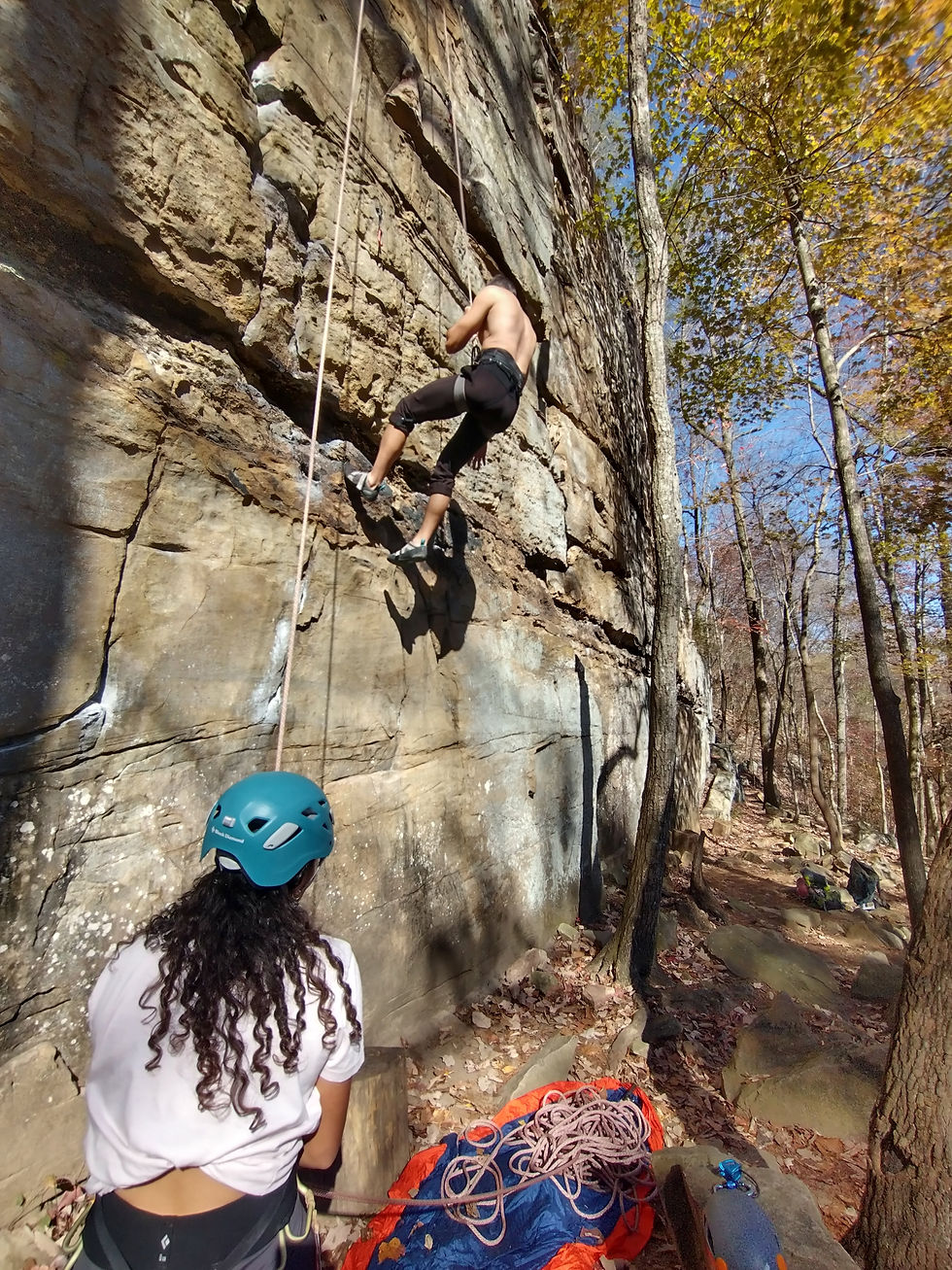
I made some progress and took a short rest break. I kept climbing. I made it to a tough spot, so I gave it a try and took a larger fall this time. After recollecting myself, I approached the section again and this time made it farther. I was almost to the next clip.
I was about three stories high when I felt exhaustion creeping on. Dan was belaying me. Becky was laying back in her hammock below. I reached out for the last hold before the next bolt. My fingers ached, my ankles and calves shook. A passing thought sounded like:
If I fall now, it will be the biggest fall I have ever taken. The last bolt was far below. I have to make this next clip. Can't fall.
"You got this dude! You're so close!" Becky shouted from her hammock.
I stretched my arm out but I couldn't reach the hold. Rebecca's encouragement gave me the strength to stretch a little further. But just as I set my fingers down, my foot slipped. I fell through the air with no consciousness of my body, just surprise and confusion. I remember seeing the sky, so I was surely staring up as I plummeted.
A couple seconds later, the rope yanked the front of my harness upwards and my body starfished. The velocity made my limbs whip backwards and my back arch. I let out a gutteral, blood-curdling "aaaugh" as any remaining oxygen lept from my lungs. My feet hand landed firmly against the wall, and when I sat up, my mind was fuzzy. To quickly test for any spinal injury, I wiggled my toes and fingers, turned my chin and scanned with my eyes. I took a deep breath.
"Are you OK?" Dan asked. Oh, sweet Dan. I am forever grateful for his support and "soft catch" during that fall. His catch of the rope prevented some dark possibilities.
"Yeah, I think I'm okay. And I want to keep climbing, but I think I should come down. That one rocked me. Thanks for the nice catch. Maybe you could try climbing this one so we don't have to leave the quickdraw."
He tried, but got stuck at the same section I did. Rebecca said she didn't think it was worth trying, so we attempted the next route nextdoor called "Miss Prissy". Another failed attempt to complete the climb meant we would be leaving two quickdraws hanging from the wall. We lost $30-45 worth of equipment because we got on some routes that we didn't expect to be so far out of our skill zone.
The night has come and I sit with Dan and Becky cooking dinner by the fire. My low back is very sore. I warm my hands and stare into the bouncing flames thinking:
That was heavy. I could have messed up my spine or gone upside down and smacked my head against the wall. Those practice-falls in Arkansas didn't prepare me for this. I lost all sense of control of my body, like I was free falling.
The next morning I awoke refreshed with no back pain. I was hesitant to get on the wall but I did anyway for a top-rope climb called "Bear Mountain Eagle" or something like that. Even on top rope, I was shaking in every move. The route felt long. My arms felt weak. My legs were trembling. Heart pounding. I was afraid in my core. It took a long time to get to the top, and I stopped a few times and forced myself to let go of the rock so I could face the reality that this rope was holding me and I would not fall. A quick few of what the route looked like from the top:

As we packed up the rope, another pair of climbers walked by to ask us how we were doing. I told them a summary of this story and admitted my fear with disappointment.
"Fear is not a bad thing. Your body is afraid because it doesn't want to die. Fear is keeping you alive," said one of the men. I nodded and acknowledged his words and they have stuck with me since.
I can use my fear to navigate risk and decision-making. I can explore by asking
Which fear is intuitive (lives in the body, comes from my core)?
Which fear is anxiously provoked (also lives in the body, but comes more from my head)?
When has my perceived-risk been greater than my actual-risk?
Rationality combined with intuition can help in a long process of healing.
Two years later, I attempted to lead my first outdoor 5.12 in southern Utah. I probably wasn't totally ready for this, but I had been practicing bigger falls and continuing to climb difficult routes. This exemplifies the results of a healing process so I may return to an activity I love.


Comments